
Part of a series introducing the focus areas of PL R&D.
Our information environment is being reshaped in real time by algorithms, networks, protocols, platforms, and adversaries that move faster than the institutions meant to govern them. Digital infrastructure, like core internet protocols, already shapes how we speak, gather, and keep our lives private. We now need to build the infrastructure that protects those freedoms faster, and more wisely, than that same infrastructure can be turned against them.
The types of freedoms we mean are specific: freedom of speech (to seek, receive, and impart information regardless of frontiers); freedom of peaceful assembly and association; the right to privacy; recognition everywhere as a person before the law; and the freedom of thought and self-determination that underwrites them all. Far from new, each was hard-won through long debate.
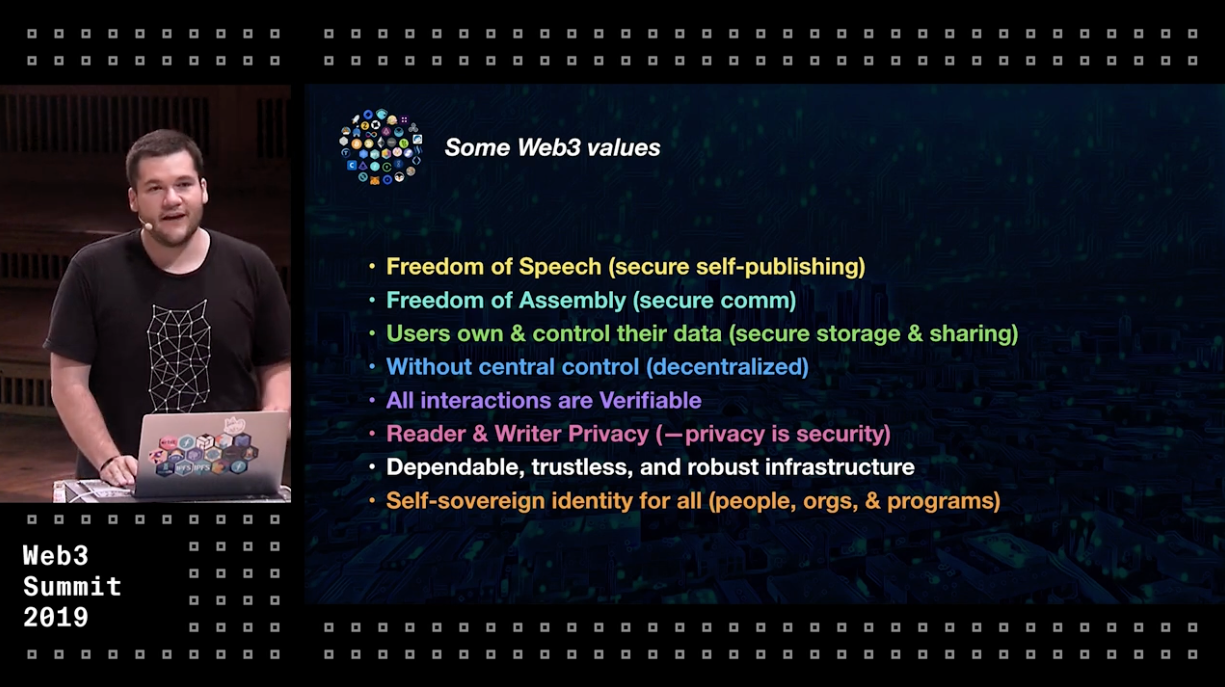
At PL R&D, we know that the infrastructure we build today will determine which of these freedoms can be exercised tomorrow. To preserve and extend them, we invest in research, funding, and product development across four interconnected opportunity spaces. These are the frontiers where a technical breakthrough can become a durable protection for a specific right, rather than one more tool for eroding it.
The framework: four layers of sovereign infrastructure
We organize our work into four layers, each sustaining specific rights:
- 1Censorship-Resistant Communication = keeping connectivity alive in low-connectivity, partitioned, or adversarial environments — sustaining freedom of expression, assembly, and association
- 2Portable Identity, Credentials & Trust = verifiable credentials and portable reputation owned by the individual, not the platform — sustaining recognition as a person before the law, and privacy
- 3Verifiable Public Knowledge & Provenance = durable, tamper-evident records and standards for non-intermediated trust — sustaining the right to seek, receive, and share accurate information
- 4Agency & Governance = privacy-preserving systems through which humans and their agents coordinate, transact, and reach consensus — sustaining self-determination and freedom of thought
These layers stack. Resilient communication is the base every other right assumes; on top of it, portable identity establishes who you are without renting that standing from a platform or state; verifiable knowledge lets a public record prove its own integrity; and open agency and governance decide whether the AI acting on your behalf extends your control or concentrates it in a few hands.
Each layer rests on the one below it — resilient communication at the base, up through identity, verifiable knowledge, and open agency & governance.
Opportunity Space 1 Censorship-Resistant Communication

What it is
Keeping communication and connectivity alive even in low-connectivity, partitioned, or adversarial environments. The frontier has moved past simple encryption toward metadata-resistance (hiding not just what you say but whom you say it to) and partition-tolerance (staying connected when the network is deliberately fragmented).
Why it matters
Speech and assembly are the first freedoms to go in any adversarial environment, and both assume you can reach other people — an assumption that residential and cellular networks, controlled by a few incumbents and the states that license them, can revoke at will.
Progress so far
Nation-state-independent connectivity is appearing: low-earth-orbit satellite networks such as Starlink decouple a person's ability to get online from the institutions that govern local access. Metadata-resistant tooling such as Kohaku (Ethereum Foundation) is productionizing Private Information Retrieval and mix networks inside a wallet, so that messages — and the patterns of who contacts whom — leak as little as possible. And modular networking stacks such as libp2p let applications find one another and stay connected even when traditional rails fail.
Communication that cannot be switched off
The step-change comes when nation-state-independent connectivity and metadata-resistant messaging reach consumer scale, so that during a deliberate shutdown a measurable share of a population stays connected and able to organize. Observable, and not yet true: a global connectivity provider offers consumer-scale service without state licensing or identity gating, and a metadata-resistant messenger crosses tens of millions of users under real adversarial conditions. At that point, censoring who may speak or gather online becomes impractical rather than merely illegal.
Opportunity Space 2 Portable Identity, Credentials & Trust

What it is
Verifiable credentials and portable reputation owned by the individual rather than the platform — for humans and, increasingly, for the agents acting on their behalf — without depending on a centralized government ID or on expert-level key management.
Why it matters
Identity is how a person is recognized, and today that recognition is mostly rented from platforms and states: lose the account or the document and you lose the standing. Without portability, people are trapped in whatever platform first issued their identity; without privacy, identity becomes a surveillance dossier. This sustains recognition as a person before the law, and privacy.
Progress so far
Open social protocols such as the Authenticated Transfer (AT) Protocol behind Bluesky give people a credible exit: identity and data bind to a portable identifier the user controls, so a whole social graph can move between providers without loss. Sybil-resistant systems such as World establish that someone is a unique human without tying that proof to a state document. And zero-knowledge credential systems — spanning age verification, passkeys, and verifiable credentials — let a person prove one specific claim while disclosing as little as possible.
Personhood without the state in the loop
The step-change comes when a service at real scale — more than 100 million people — verifies unique humans for everyday services without anchoring them to a nation-state identity or KYC. Observable, and not yet true: today's proof-of-personhood systems operate well below that scale and outside mainstream services. When one crosses it, recognition as a person need no longer be rented from a state or a platform, and privacy-preserving personhood becomes safe to build on.
Opportunity Space 3 Verifiable Public Knowledge & Provenance

What it is
Durable, tamper-evident records and standards for non-intermediated trust: systems that can prove a knowledge artifact has not been altered, and keep proving it over time.
Why it matters
The rights to seek, receive, and share information depend on a shared public record people can trust. The ability to prove a piece of information is authentic has always underpinned that record, and as AI-generated content floods the internet that ability gets far more fragile and far more urgent. As global truth gets harder to verify, trust retreats into small private circles — a dark forest in which a common, checkable account of what happened ceases to exist.
Progress so far
Content addressing, as in IPFS, gives every file a verifiable identifier derived from its contents, so a reader can confirm data is exactly what was published. Provenance frameworks such as Starling Lab establish verifiable chains of custody for journalism and historical records. Large-scale archives such as the Internet Archive preserve digital history at scale. And formal-verification systems such as Lean, with zero-knowledge proofs of execution, extend provenance from documents to the computations that produced them.
Provenance becomes the default for truth
The step-change comes when content authenticity stops being optional. Observable, and not yet true: two consecutive generations of frontier AI models ship attested provenance tooling by default, and at least one major platform or archive adopts content-addressed provenance as the default for its public record. As synthetic content becomes indistinguishable from the real thing, a public record that can prove its own integrity becomes the precondition for accurate information meaning anything at all.
Opportunity Space 4 Sovereign Infrastructure for AI & Agents
What it is
The open environment — compute, storage, and identity — that lets AI agents coordinate and transact on our behalf: open enough to be permissionless, accountable enough to keep humans in charge.
Why it matters
AI is becoming a powerful extension of each of us and of the institutions around us, and the open question is whether that capability stays under individual human control or concentrates in a few hands. An agent that acts on your behalf only extends your agency if you, and not a single platform, govern the compute, storage, and identity it runs on. This is where self-determination and freedom of thought are won or lost.
Progress so far
Open storage markets such as Filecoin run on independent providers rather than one centralized host, so no single party can deny, alter, or lose your data. Fully homomorphic encryption environments such as Zama let computation run directly on encrypted data, so agents can coordinate in public without exposing what they hold. And open compute protocols such as Gensyn and Prime Intellect train models across independent, globally distributed hardware rather than inside a single lab.
Agents run on open rails
The step-change comes when serious AI capability no longer requires a single provider's stack. Observable, and not yet true: a frontier-scale model is trained across independent, decentralized hardware rather than one company's cluster, or a meaningful share of agent-to-agent economic activity settles on open, permissionless compute, storage, and identity rather than inside one platform. At that point the rights architecture of the agent economy is set in the open rather than by whoever owns the cluster.
Building the field
The next few years will decide whether these freedoms are quietly curtailed or deliberately extended. Human freedom can be hollowed out when infrastructure is centralized, surveilled, or switched off, and PL R&D focuses on the root system a free digital society stands on. We do not build every piece; we connect them, and aim our toolkit — field-building communications, convenings, grants, venture support, and policy and standards work — at the blockers specific to this field. (That toolkit is described in the PL R&D Overview.) PL's foundational primitives here — IPFS, libp2p, and content-addressed data — are among the strongest in the portfolio.
Get involved
If you are working on any of these four layers, we want to hear from you:
- Founders and researchers building censorship-resistant communication, portable identity, verifiable provenance, or agent infrastructure: tell us what you are building and where you are stuck.
- Investors and funders who want to co-fund this frontier or respond to a specific Request for Startups.
- Policymakers, journalists, and civil-society groups who depend on these guarantees in practice: partner with us on real-world deployments and the evidence that comes from them.
We invite you to explore the projects already contributing to this vision. Reach us at research@protocol.ai.
The rights we refuse to lose will be defended in the infrastructure, or not at all. Join us.
This post is for informational purposes only. It is not an offer, solicitation, or recommendation of any security or investment product, and nothing here is a commitment or guarantee of any future performance or any outcome.